
Financial cyber threats in 2013. Part 1: phishing
1.
Financial cyber threats in 2013. Part 1: phishing
o
Introduction: Money and risks in a multi-device world
§
Targets
§
Financial attacks: worrying trend
§
A closer look at financial phishing targets
§
Deeper into the dynamics of attacks
§
Phishing against OS X: first signs of a growing threat
Introduction: Money and risks in a multi-device world
It has been quite a few years since cybercriminals started actively stealing
money from user accounts at online stores, e-payment systems and online banking
systems. However, for much of that time the financial fraudsters' sphere of
activity was restricted by a number of factors, in particular the relatively
limited scope of electronic payment tools.
In recent years, electronic money has been growing in importance. The
convenience and universal accessibility of electronic payment systems and online
banking services attract huge numbers of users, and in many countries banks and
financial institutions are seriously considering the complete discontinuation of
cash flow in favor of cash-free payments. A 2013
survey
conducted by B2B International in cooperation with Kaspersky Lab also
demonstrates the growing popularity of digital payments: 98% of those polled say
they regularly use online banking or payment systems, or shop online.
This increasing popularity of cash-free transactions is accompanied by growing
numbers of devices on which financial transactions can be made. As demonstrated
by the same survey, PCs and laptops are still the "main" devices from which
users access financial services: 87% of respondents said they conduct operations
involving electronic money using a desktop or laptop computer. However, the
share of mobile devices used for the same purposes is substantial: 22% and 27%
of those polled respectively use tablets or smartphones for some financial
operations.
Of course, these trends attracted unwanted attention. The dramatic growth in the
number of users of all types of payment systems has attracted cybercriminals,
and they are investing ever-growing resources into fraud schemes with which they
can first gain access to users' financial data and then to their actual money.
Although financial attacks are among the most complicated and expensive types of
attacks, they are also highly lucrative because, once successful, they provide
direct access to the victims' money. Once an online banking account is accessed,
all that remains is to take the money and cash it in, whereas a malware writer
or the owner of a botnet designed to launch DDoS attacks or send spam still has
to find clients to buy their services.
For over 16 years, Kaspersky Lab has developed tools to protect against all
types of cyber attacks, including financial attacks. The development of such
technologies is impossible without routine detailed analysis of new malware
samples, social engineering methods and other tools used by cybercriminals
involved in financial fraud. One of the most general conclusions that can be
drawn from this analysis is that, unlike many other types of attacks, financial
malware attacks typically incorporate a highly diverse set of instruments – from
phishing pages imitating the legitimate websites of financial institutions, to
exploiting vulnerabilities in popular software and the writing of customized
malicious programs.
Since financial cyber attacks are complex, an analysis of how they impact user
security requires a comprehensive approach. That's why when preparing this
report, Kaspersky Lab's experts considered Windows threats alongside threats
targeting OS X and Android; "specialized" malware as well as other programs that
are potentially capable of stealing financial data; and not only the spread of
dangerous Trojans but also phishing attacks that can be an effective tool to
coax valuable financial data from unwary users. In Kaspersky Lab's view, this
comprehensive approach is the only way to achieve the goal of this study, which
was to give the broadest possible picture of the cyber-threat landscape aimed at
online finances, and to attempt to evaluate the magnitude of the danger that
such cyber threats pose.
Methodology of the report
The study used de-personalized data obtained from
Kaspersky Security Network.
The Kaspersky Security Network is a globally distributed cloud-based
infrastructure designed for the real-time processing of data about threats that
Kaspersky Lab users encounter. Kaspersky Security Network was created to ensure
that information about the most recent threats is delivered to Kaspersky Lab
product users as quickly as possible. With this network, an information for a
new threat is added to databases within minutes of a previously unknown threat
being discovered. KSN's other function is to collect depersonalized statistics
about threats which land on user computers. It is each user's voluntary decision
to provide their information to KSN. Data received in this way was used as the
basis for this report.
The researchers studied data about the number of times Kaspersky Lab components
successfully protected against phishing (under Microsoft Windows and Apple OS
X), malware (under Windows) and mobile malware (under Google Android). In
addition it looked at statistics about the number of users attacked. The
research also analyzes information about the geographic spread of the attacks
and their intensity.
The research covers the entire year of 2013; the data is analyzed in comparison
to the equivalent data collected in 2012. The main subject of the research is
the targets of phishing campaigns: the number of blocked attempts to download
fake sites of payment systems, online banking systems, online stores and other
targets associated with financial institutions. In addition, Kaspersky Lab's
experts selected a few dozen malware samples created specifically to steal
financial data, and analyzed how frequently they were observed "in the wild"
during the research period.
As the crypto-currency Bitcoin became extremely popular in 2013, Kaspersky Lab's
experts separated threats associated with the generation and stealing of this
currency into a separate category, and followed their evolution.
Main findings
According to the information collected from the protection sub-systems of
Kaspersky Lab products, 2013 saw a dramatic increase in the number of
finance-related attacks.
Below are the main findings of the research:
·
31.45% of all phishing attacks in 2013 targeted financial institutions
·
22.2% of all attacks involved fake bank websites; the share of banking phishing
doubled compared with 2012.
·
59.5% of banking phishing attacks exploited the names of just 25 international
banks. The rest of the attacks used the names of 1000+ other banks.
·
38.92% of all instances that required intervention by Kaspersky security
technologies on Mac computers were triggered by "financial" phishing sites.
Further on in the research text, we will discuss in more detail how attacks
develop over time, look at their geographical distribution, and see the lists of
their targets.
Phishing threats
Phishing, or creating fake copies of sites to obtain confidential user data, is
a very common cyber threat. This is largely due to the fact that to deploy the
simplest phishing campaign, cybercriminals do not need to have specific
programming knowledge – it's enough to have certain skills in creating web
pages. The main purpose of phishing is to convince the victims they are visiting
a real site, not a fake one. These attempts are often successful so phishing
campaigns are used both as the main tool to obtain sensitive user information
and as part of a complex attack to lure users to a site from which malware will
be downloaded on to their device.
According to our study, phishing pages are frequently used in cyber attacks
aimed at stealing user financial data. However, before proceeding to the
detailed analysis of these attacks it would be helpful to present the general
picture of phishing threats in 2013.
Attacks and users
Kaspersky Lab protection products have four sub-systems to combat phishing
attacks. Phishing databases (similar to the malicious file signature databases)
are stored on user devices and contain a list of the most common phishing links
active when the database was released. The second sub-system is an anti-phishing
cloud database that Kaspersky Lab protection products consult if a user notices
a suspicious link that has not yet been included in the local anti-phishing
database. The cloud database is updated faster than the local ones and is
designed to detect the very latest phishing attacks
Kaspersky Lab products also integrate two automatic systems for detecting
phishing links and pages: Mail anti-phishing and Web anti-phishing. Mail
anti-phishing monitors the links in users' emails if they work with one of the
popular email clients (Microsoft Outlook, etc.). Web anti-phishing checks
everything that appears in the users' browsers, utilizing a set of heuristic
rules, and is capable of detecting new phishing pages even if there is no
information about them in any database.
For this report, Kaspersky Lab used just the data obtained from Web
anti-phishing because this is generally only called upon when information about
a new phishing page is missing from Kaspersky Lab's databases. Moreover, it
makes it possible to determine the target of the phishing attack
Web anti-phishing share in overall number of detects in 2013
According to Kaspersky Lab, in 2013 about 39.6 million users faced phishing
attacks, an increase of 2.32% from 2012.
Over 600 million notifications about the phishing links and pages encountered by
our users arrived from all four Kaspersky Lab anti-phishing sub-systems. In 2012
this figure was almost the same. At the same time the number of attacks blocked
by heuristic Web anti-phishing increased by 22.2% over the same period – from
270 million in 2012 to about 330 million in 2013. This may be due to the
constant improvements made to the heuristic detection system.
Geography of attacks
In 2013, the majority of phishing attacks blocked by Kaspersky Lab (30.8%)
targeted users in the USA. Second came Russia (11.2%) followed by Germany
(9.32%).
Most frequently attacked countries in 2013
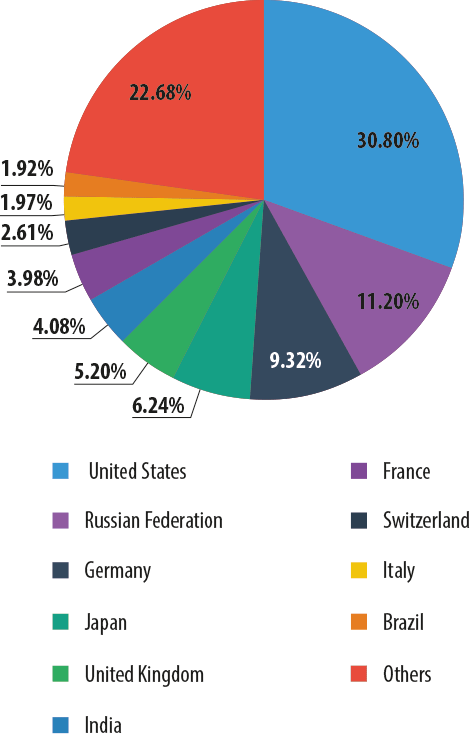
Here and below, the data is provided by Kaspersky Security Network.
Compared to the previous year, in 2013 the list of the most frequently attacked
countries saw significant changes. For example, the share of attacks on Russian
users declined by 9.19 percentage points while the percentage of attacks on
users in the USA increased considerably – from 17.56% in 2012 to 30.8% in 2013.
The proportion of attacks on German users also grew by 3.49 pp, from 5.83% to
9.32%.
There could be several reasons for this geographical distribution. We have
already seen a reduction in the amount of attacks in some countries and
increases in other countries. The decline might be the result of such factors as
enhancing measures to combat cybercrime, more complex domain name registration
procedures, etc. The growth may be triggered by a "natural" increase in the
total number of Internet users and individual Web resources: social networking
sites, Internet stores, etc. The more often people download web pages, the more
likely they are to encounter phishing pages.
Targets
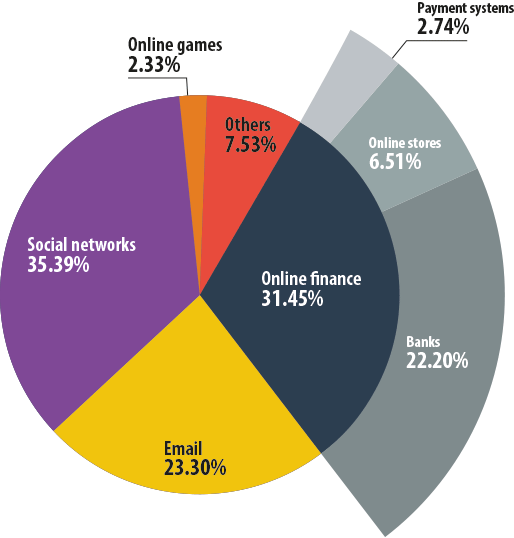
As seen from the chart below, the majority of attacks in 2013 mimicked social
networking sites – about 35.4%. Financial and phishing targets – fake banking
sites, payment systems and online stores – accounted for 31.45%. Mail services
came third with 23.3% of attacks.
Phishing targets in 2013
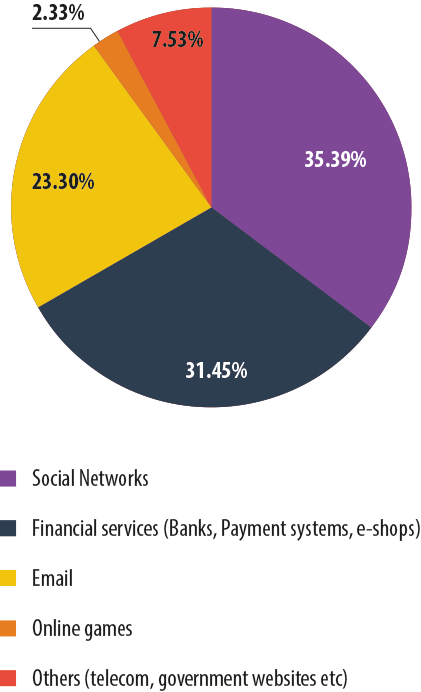
Noticeably, in comparison with 2012, the distribution of targets by type changed
significantly in 2013. The share of attacks using fake social networking pages
increased by 6.79 pp and reached 35.39%, while the percentage of financial
attacks grew by 8.5 pp and accounted for 31.45%. At the same time, the
proportion of attacks exploiting fake websites of mail services decreased by
10.5 pp to 23.3% and online games dropped from 3.14% in 2012 to 2.33% in 2013.
Phishing targets in 2012 and 2013
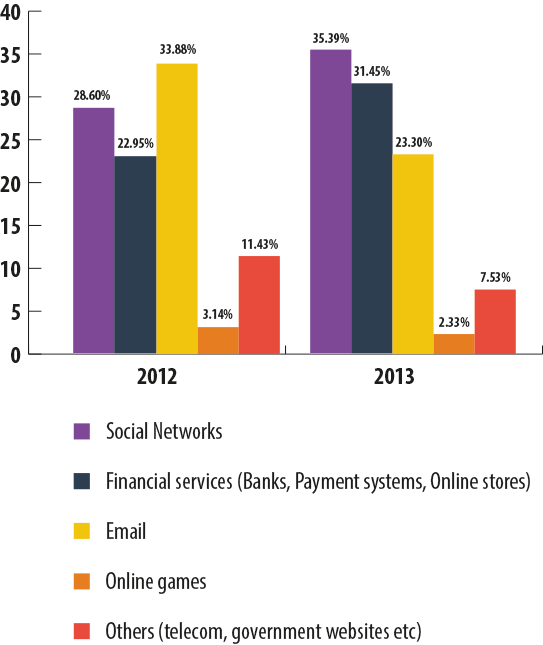
Financial attacks demonstrated the most notable growth in 2013 compared to 2012,
which gives rise to a more detailed analysis of the dynamics of such attacks.
Financial attacks: worrying trend
In 2012, 22.95% of all phishing attacks targeted financial services of one kind
or another: 11.92% of all attacks were performed using fake bank and online
banking sites, 5.66% targeted online stores, and 5.37% targeted payment system
sites.
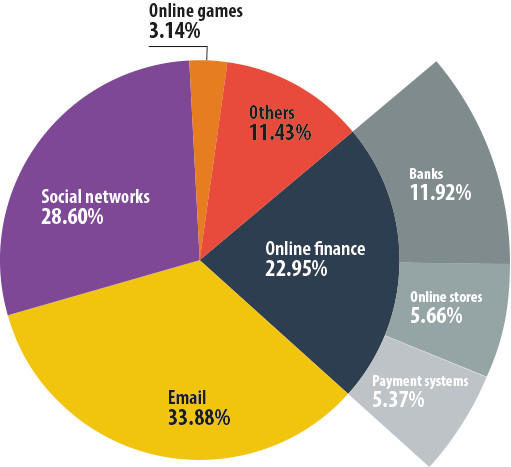
Financial phishing in 2012
However, in 2013 the distribution of attacks within the ‘Online Finance'
category changed dramatically. The percentage of phishing targeting banks almost
doubled and reached 22.2%. The share of online stores increased insignificantly
– from 5.66% to 6.51% – while the proportion of payment systems dropped by 2.63
pp. The conclusion here is obvious: the attackers are increasingly focusing on
bank web services and this is one of the strongest trends in the area of
phishing threats.
Financial phishing targets in 2013
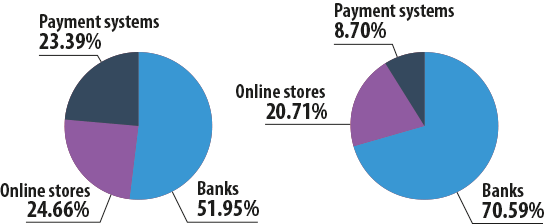
The trend is even more clear-cut when financial phishing is separated from the
other categories. In 2013, fake bank pages made up 70.59% of all Kaspersky Lab
Web anti-phishing detections in the Online Finance category, but one year
earlier the share of bank phishing was only 51.95%.
The percentage of attacks on online stores decreased from 24.66% in 2012 to
20.71% in 2013 while the proportion of attacks on payment systems fell from
23.39% to 8.7%.
Financial phishing only in 2012 | Financial phishing only in 2013
A closer look at financial phishing targets
Banks
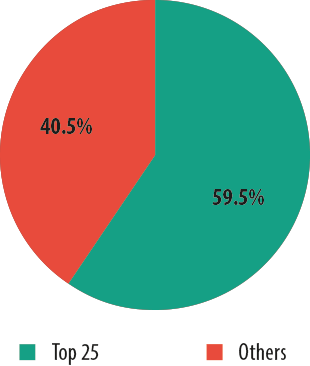
Although Kaspersky Lab anti-phishing databases contain more than a thousand
names of banks that have been attacked or are at risk of being attacked due to
their popularity, the vast majority of all phishing attacks using fake bank
pages exploited the names of just 25 organizations.
In 2013, these 25 banks attracted about 59.5% of all "bank" attacks. However,
most of these organizations are the largest international banking brands,
operating in dozens of countries worldwide. Widespread brand recognition is one
of the main tools of the phishers: the more popular the brand, the easier it is
for cybercriminals to use its name to lure users to a fake website.
Attacks against banks in 2013
Payment systems
As with attacks on banks, the distribution of attacks on payment systems largely
depends on brand awareness – almost 90% of phishing attacks in this category
fell on one of five international brands: PayPal, American Express, MasterCard
International, Visa or Western Union
Attacks against payment systems in 2013
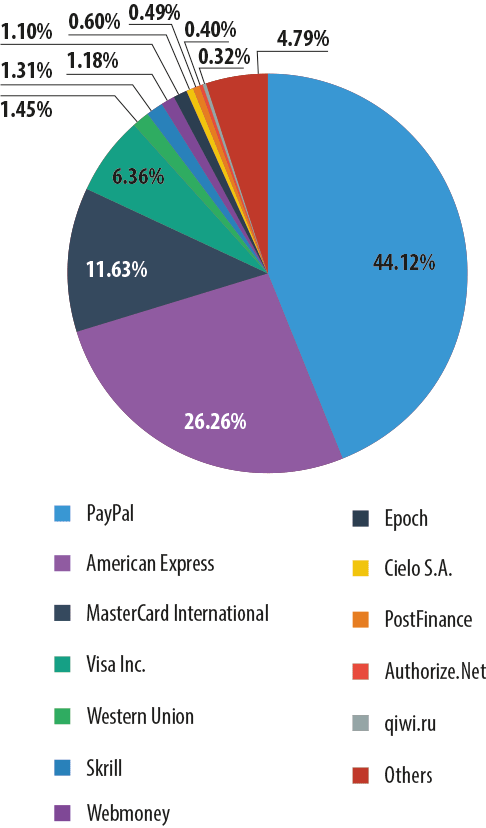
PayPal, being an extremely popular system for making online payments, is equally
popular with hackers – the amount of attacks on this system reached 44.12%.

An example of a phishing page imitating the PayPal website
A significant proportion of attacks imitated American Express – 26.26%.
MasterCard International and Visa Inc. pages are targeted much less often: these
systems accounted for 11.63% and 6.36% of attacks respectively.

An example of a phishing page imitating the Visa website
Online shops
For several years in a row Amazon.com (61.11% in 2013) has been the most popular
cover for phishing attacks in the Online Stores category.

An example of a fake Amazon page targeting users in Germany
As the world's largest online store, offering a wide range of goods, Amazon is
familiar to many users. Therefore, it is popular with fraudsters who create fake
pages.
A significant proportion of attacks (12.89%) use the Apple brand name.
Generally, the attackers try to imitate the pages of online stores selling Apple
devices as well as App Store and iTunes Store.
Attacks against online shops in 2013
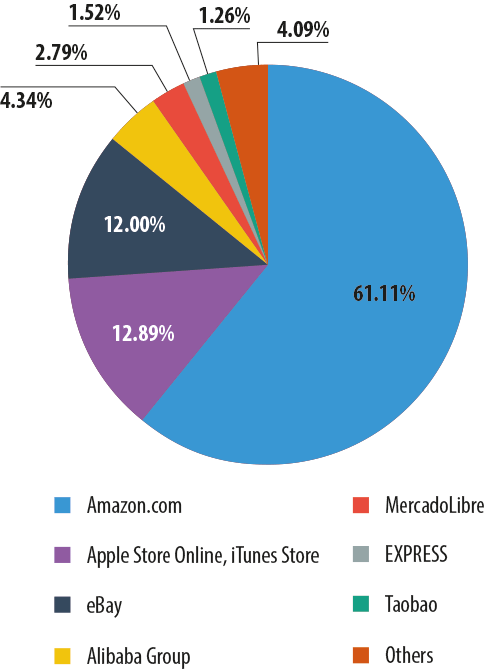
Among the traditional phisher targets is the Internet auction site eBay (12%),
and the Chinese online store Alibaba (4.34%) is becoming increasingly attractive
for scammers. In 2013 it was joined by another Chinese online store – Taobao
(1.26%). Almost 3% of all attacks on online stores fell on MercadoLibre.com, a
South American version of eBay. The diagram above illustrates the
"international" character of financial phishing. As can be seen, the victims of
attacks are not only English-speaking users but also people who speak Chinese,
Spanish, Portuguese, and several other languages.
Deeper into the dynamics of attacks
The professional and marketing activities of the companies that are exploited in
phishing schemes also affects the number of attacks.
This trend can be illustrated by the graph of attacks which exploited the Apple
brand name.
Attacks exploiting the Apple brand name in the 2nd half of 2013
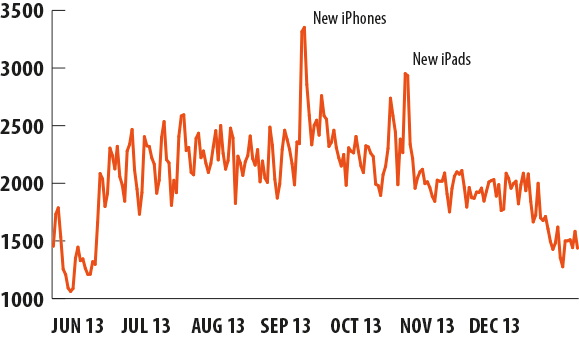
Over the year, the dynamics of Kaspersky Lab security technology detections of
threats that exploit Apple's trademark had been a series of peaks and troughs
ranging from 1 to 2,500 operations per day. However, as seen from the chart
above, there were two noticeable peaks which coincided with the date iPhone 5s
and 5c were announced on 10 September 2013 and the announcement of iPad Air and
iPad Mini with retina-display on 22 October 2013.
The logic in this case is clear: Apple devices are always a hot topic for news
and discussion on the Internet, particularly when a new product is about to be
released. For the fraudsters, using "hot" keywords is the usual way of
attracting audiences to fake sites and, as the graph shows, this method works.
Apple is not the only phisher target that shows a correlation between the number
of attacks and the company's activities. Natural disasters and high-profile
international events attract active coverage and discussion in the media and on
the Internet, giving rise to the emergence of so-called thematic phishing and
spam. Similarly, large-scale marketing campaigns held by a bank, an e-store or
other commercial or financial organizations may become a pretext for phishing
The logical conclusion for banks, payment systems and other financial
institutions regularly conducting online marketing activities is simple: when
initiating an advertising campaign to attract new business, don't forget to warn
customers about potential cyber threats.
Phishing against OS X: first signs of a growing threat
The number of malicious attacks on the owners of computers running OS X has
always been significantly lower than the number of attacks on Windows users.
This can be easily explained: although Apple actively promotes its Mac computers
and laptops all over the world, the number of users of these devices is a long
way short of the number of computers running under Windows. Since criminals are
keen to maximize their profits, they naturally pay more attention to Windows
users. However, this statement is only valid when it comes to malware. The
attacker does not need to do anything special to attack a Mac user via phishing:
although Windows and OS X have fundamental differences which make it impossible
to write "universal" malicious programs for both platforms, the users of both
PCs and Mac download the same web pages and phishing threats which spread with
the help of social engineering techniques are as dangerous for Mac users as they
are for Windows users. The results of Kaspersky Lab's study confirm this fact.
However, it should be noted here that for technical reasons Kaspersky Lab only
became capable of collecting relevant statistics from Mac users in November 2013
and all Mac-related information in this study was harvested in November and
December 2013. Although the observation period is short, the data obtained
provides some insight into the landscape of threats jeopardizing OS X users and
helps to define differences compared with the overall picture.
In 2013, 7.8% of Kaspersky Lab anti-phishing detections protected Mac computers.
Almost half of these attacks targeted US users (47.55%); 11.53% of attacks were
registered in Germany and 5.47% in the UK. The list of the most frequently
attacked countries also included Sweden and Australia.
Most frequently attacked countries: Mac users
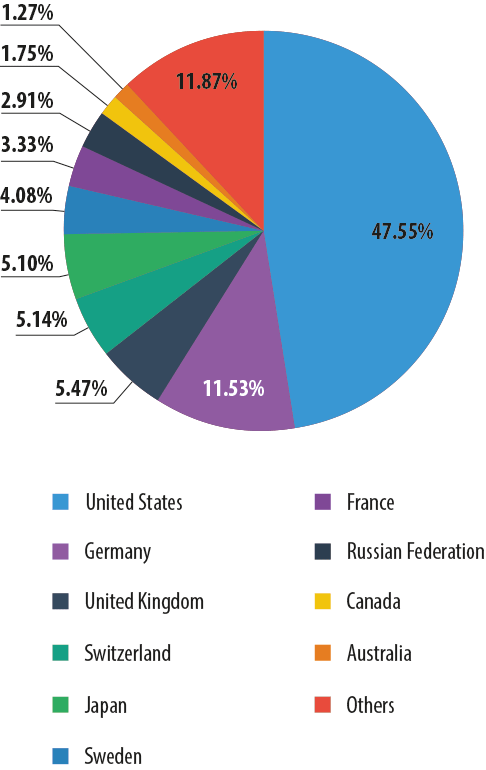
The differences in the distribution of attacks by country can be explained by
the relative use of Apple computers in these countries. Traditionally, the USA
and the developed European countries are the largest markets for Apple devices.
Mac owners faced phishing attacks as often as the users of computers running
Windows, but their chances of becoming a victim of a financial attack are even
greater.
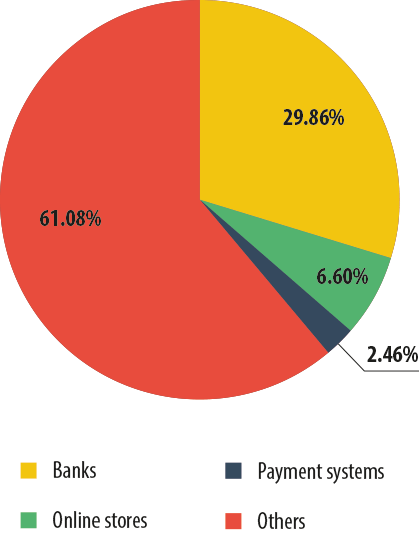
Over the reporting period, about 38.92% of all Kaspersky Lab anti-phishing
detections on Apple computers involved "financial" phishing pages. That is
almost 7.5 percentage points more than the "financial" share of the total volume
of attacks. 29.86% of the total number of attacks occurred when users were
trying to enter fake bank sites; online stores and auctions accounted for 6.6%,
while payment systems accounted for 2.46% of all anti-phishing detections.
Financial phishing: Mac
That was the view Kaspersky Lab's experts took on financial phishing in the year
2013. Although phishing is a fairly common threat, when it comes to financial
cybercrime it forms a relatively small part of the overall landscape of
financial cyber threats. The key role here is played by financial malware,
dangerous software capable of obtaining user details to access online accounts
and steal the victim's money. This will be discussed in the next part of the
Kaspersky Lab report.
To be continued...
Finanzielle Cyberbedrohungen im Jahr 2013.
Teil 1: Phishing
1.
Finanzielle Cyberbedrohungen im Jahr 2013. Teil 1: Phishing
o
Einführung: Geld und Risiken in einer Multi-device
§
Ziele
§
Finanzielle Angriffe: beunruhigende Tendenz
§
Ein genauerer Blick auf finanzielle Phishing Ziele
§
Tiefer in die Dynamik der Angriffe
§
Phishing gegen OS X: erste Anzeichen für eine wachsende Bedrohung
Einführung: Geld und Risiken in einer Multi-device
Es seit schon einige Jahre Cyberkriminellen aktiv stehlen Geld von
Benutzerkonten bei online-Shops, e-Payment-Systeme und online-Banking-Systeme.
Für die meiste Zeit war jedoch die finanziellen Betrügern Tätigkeitsbereiche
durch eine Reihe von Faktoren, insbesondere der relativ begrenzten Rahmen
elektronischer Zahlungsverkehr Werkzeuge beschränkt.
In den letzten Jahren hat die e-Geld an Bedeutung zugenommen. Die Bequemlichkeit
und universelle Zugänglichkeit für elektronische Zahlungssysteme und
online-Banking-Dienstleistungen ziehen riesige Anzahl von Benutzern, und in
vielen Ländern Banken und Finanzinstitute sind ernsthaft in Erwägung die
vollständige Einstellung der Cashflow zu Gunsten von bargeldlosen Zahlungen.
Einer durchgeführten B2B International in Zusammenarbeit mit Kaspersky Lab 2013-
Umfrage
zeigt auch die wachsende Popularität der digitalen Zahlungen: 98 % der Befragten
sagen, sie regelmäßig verwenden, online-Banking oder Zahlungssysteme, oder
online kaufen.
Diese zunehmende Popularität von bargeldlosen Transaktionen wird begleitet durch
die wachsende Anzahl von Geräten, die über die finanzielle Transaktionen
ausgeführt werden können. Wie von der gleichen Umfrage gezeigt hat, PCs und
Laptops sind immer noch die "Haupt" Geräte, die aus dem Zugriff auf
Finanzdienstleistungen: 87 % der Befragten sagten, sie führen Operationen, die
e-Geld-mit einem Desktop oder Laptop-Computer. Jedoch ist der Anteil der mobilen
Geräten für die gleichen Zwecke verwendet beträchtlich: 22 % und 27 % der
Befragten bzw. Verwendung Tabletten oder Smartphones für einige finanzielle
Vorgänge.
Natürlich erregte diese Trends unerwünschte Aufmerksamkeit. Die dramatische
Zunahme der Anzahl der Benutzer aller Arten von Zahlungssystemen hat
Internetkriminelle angezogen, und sie investieren immer mehr Ressourcen in
Betrugsdelikten, mit denen sie zunächst Zugang zu finanziellen Daten von
Benutzern und dann ihre eigentliche Geld gewinnen können. Obwohl finanzielle
Angriffe unter den sehr aufwendigen und teuren Arten von Angriffen sind, sind
sie auch äußerst lukrativ, da einmal erfolgreich, sie direkten Zugang zu den
Opfern Geld bieten. Sobald ein online-Banking-Konto zugegriffen wird, bleibt
lediglich zu kassieren und cash-in, während noch verfügt ein
Malware-Schriftsteller oder der Besitzer eines Botnets zur DDoS Angriffe oder
Spam zu senden, Kunden, ihre Dienste zu kaufen zu finden.
Seit über 16 Jahren hat Kaspersky Lab Werkzeuge zum Schutz gegen alle Arten von
Cyber-Angriffen, einschließlich der finanziellen Angriffe entwickelt. Die
Entwicklung solcher Technologien ist unmöglich ohne Routine detaillierte Analyse
der neuen Malware-Proben, Social-Engineering-Methoden und andere Tools von
Cyberkriminellen Finanzbetrug beteiligt. Eine der allgemeinsten
Schlussfolgerungen, die aus dieser Analyse gezogen werden kann ist, dass im
Gegensatz zu vielen anderen Arten von Angriffen, finanzielle Malware-Angriffe in
der Regel eine sehr vielfältige Reihe von Instrumenten – von Phishing-Seiten,
die Nachahmung der seriöse Websites von Finanzinstituten, die Ausnutzung von
Schwachstellen in beliebten Software und das Schreiben von angepasste
Schadprogramme enthalten.
Da finanzielle Cyber-Attacken komplex sind, erfordert eine Analyse der
Auswirkungen auf Benutzersicherheit einen umfassenden Ansatz. Deshalb ist bei
der Erstellung dieses Berichts angesehen Experten von Kaspersky Lab Windows
Bedrohungen neben Bedrohungen für OS X und Android; "spezialisierte" Malware
sowie andere Programme, die möglicherweise von Finanzdaten zu stehlen; und nicht
nur die Verbreitung von gefährlichen Trojaner sondern auch Phishing-Angriffe,
die ein wirksames Instrument zur Koax-wertvoller Finanzdaten aus unvorsichtige
Nutzer sein können. Kaspersky-Lab Ansicht ist dieser umfassende Ansatz der
einzige Weg zur Erreichung des Ziels dieser Studie, die war, das weitesten
mögliche Bild von Cyber-Bedrohungen zur online Finanzen zu geben und zu
versuchen, das Ausmaß der Gefahr bewerten, die solche Cyberbedrohungen
darstellen.
Die Studie verwendet de personalisierte Daten aus
Kaspersky Security Network.
Kaspersky Security Network ist ein global verteilte Cloud-basierte Infrastruktur
für die Echtzeit-Verarbeitung von Daten über Bedrohungen, die Kaspersky Lab
Benutzer auftreten. Kaspersky Security Network wurde geschaffen, um
sicherzustellen, dass Informationen über die jüngsten Drohungen Anwender von
Kaspersky Lab Produkten so schnell wie möglich zugestellt wird. Mit diesem
Netzwerk ist eine Information für eine neue Bedrohung Datenbanken innerhalb von
Minuten eine bisher unbekannte Bedrohung entdeckt wurde hinzugefügt. KSN der
anderen Funktion ist entpersönlichten Statistiken über Bedrohungen zu sammeln,
die auf Benutzercomputern landen. Es ist jedes Benutzers freiwillige
Entscheidung, ihre Informationen zu KSN liefern. Auf diese Weise erhaltenen
Daten diente als Grundlage für diesen Bericht.
Die Forscher untersuchten Daten über die Häufigkeit der
Kaspersky-Lab-Komponenten erfolgreich gegen Phishing (unter Microsoft Windows
und Apple OS X), Malware (unter Windows) und mobiler Malware (unter Google
Android) geschützt. Außerdem sah es Statistiken über die Anzahl der Benutzer
angegriffen. Die Forschung analysiert auch Informationen über die geographische
Verbreitung der Angriffe und ihre Intensität.
Die Forschung umfasst das ganze Jahr 2013; im Vergleich zu die entsprechende
Datenerhebung im Jahr 2012 werden die Daten analysiert. Das zentrale Thema der
Forschung ist das Ziel von Phishing-Kampagnen: die Anzahl der blockierten
versucht gefälschte Sites von Zahlungssystemen, online-Banking-Systeme,
online-Shops und andere Ziele, die mit Finanzinstituten verbundenen download.
Darüber hinaus Experten von Kaspersky Lab ausgewählt ein paar Dutzend Malware
Samples erstellt speziell für Finanzdaten zu stehlen, und analysiert, wie oft
sie "in the Wild" während der Laufzeit beobachtet wurden.
Als die Crypto-Währung Bitcoin in 2013 extrem populär wurde, Experten von
Kaspersky Lab getrennt Gefahren verbundenen und dieser Währung in eine eigene
Kategorie zu stehlen, und folgte ihrer Entwicklung.
Nach den Informationen, zusammengestellt von der-Sub-Schutzsysteme von Kaspersky
Lab sah 2013 einen dramatischen Anstieg der Zahl der Finance-ähnliche Angriffe.
Im folgenden sind die wichtigsten Erkenntnisse der Forschung:
·
31,45 % aller Phishing-Angriffe im Jahr 2013 gezielt Finanzinstitute
·
22,2 % aller Angriffe mit gefälschten Bank-Websites. der Anteil der Banken
Phishing verdoppelt im Vergleich zu 2012.
·
59,5 % Banking Phishing-Angriffe ausgenutzt, die Namen der nur 25 internationale
Banken. Der Rest der Anschläge verwendet die Namen der 1000 + andere Banken.
·
38.92 % aller Instanzen, die Intervention von Kaspersky Sicherheitstechnologien
auf Mac-Computern benötigt wurden durch "finanzielle" Phishing-Seiten ausgelöst.
Weiter besprechen auf in der Forschung-Text ausführlicher wir wie Angriffe
entwickeln im Laufe der Zeit, betrachten ihre geografische Verteilung und finden
Sie die Listen ihrer Ziele.
Phishing und gefälschte Kopien von Seiten vertrauliche Benutzerdaten erhalten
ist eine sehr häufige Cyber-Bedrohung. Dies ist weitgehend zurückzuführen, dass
für die Bereitstellung die einfachste Phishing-Kampagne Internetkriminelle nicht
spezifische Programmierkenntnisse haben müssen-es ist genug, um bestimmte
Kenntnisse in der Erstellung von Webseiten. Der Hauptzweck der Phishing ist die
Opfer davon zu überzeugen, dass sie eine echte Website, nicht eine gefälschte
besuchen. Diese Versuche sind oft erfolgreich, so Phishing-Kampagnen verwendet
werden, als das wichtigste Instrument um vertraulichen Benutzerinformationen zu
erhalten und als Teil eines komplexen Angriffs um Benutzer auf eine Website zu
locken, aus denen Malware auf ihrem Gerät heruntergeladen wird.
Laut unserer Studie werden Phishing-Seiten häufig Cyber-Attacken, die darauf
abzielen, finanziellen Daten zu stehlen. Jedoch bevor Sie fortfahren, die
detaillierte Analyse dieser Angriffe wäre es, das allgemeine Bild der
Phishing-Bedrohungen im Jahr 2013 zu präsentieren hilfreich.
Kaspersky Lab Pflanzenschutzmittel haben vier Sub-Systeme zur Bekämpfung von
Phishing-Angriffen. Phishing-Datenbanken (ähnlich wie die infizierte
Datei-Signatur-Datenbanken) auf Endgeräte gespeichert werden und enthalten eine
Liste der häufigsten Phishing-Links aktiv, als die Datenbank freigegeben wurde.
Die zweite Sub-System ist eine Anti-Phishing-Wolke-Datenbank, die Kaspersky Lab
Pflanzenschutzmittel zu konsultieren, wenn ein Benutzer einen Verdächtigen Link
bemerkt, der noch nicht in der lokalen Anti-Phishing-Datenbank aufgenommen
wurde. Die Cloud-Datenbank ist schneller als die lokale aktualisiert und wurde
entwickelt, um die neuesten Phishing-Angriffe erkennen
Kaspersky Labs Produkte integrieren auch zwei automatische Systeme zur Erkennung
von Phishing-Links und Seiten: Mail-Anti-Phishing und Web-Anti-Phishing. E-Mail
Anti-Phishing überwacht die Links in e-Mails von Nutzern, wenn sie mit einem der
gängigen e-Mail-Clients (Microsoft Outlook, etc.) zu arbeiten. Web Anti-Phishing
überprüft alles, was erscheint im Browser der Benutzer, unter Verwendung einer
Reihe von heuristischen Regeln und ist in der Lage neue Phishing-Seiten zu
erkennen, auch wenn es keine Informationen über sie in einer Datenbank.
Für diesen Bericht verwendet Kaspersky Lab nur die Daten, die von
Web-Anti-Phishing erreicht werden, weil dies in der Regel nur auf aufgerufen
wird, wenn Informationen über eine neue Phishing-Seite von Kaspersky-Lab
Datenbanken fehlt. Darüber hinaus macht es möglich, das Ziel der
Phishing-Attacke zu bestimmen
Web-Anti-Phishing-Anteil an Gesamtzahl der erkennt im Jahr 2013
Laut Kaspersky Lab, in 2013 rund 39,6 Millionen Benutzer
konfrontiert-Phishing-Angriffe, eine Steigerung von 2,32 % ab 2012.
Mehr als 600 Millionen Meldungen über Phishing-Links und Seiten auf, die von
unseren Nutzern auftreten kam aus alle vier Kaspersky Lab Anti-Phishing
Subsysteme. Im Jahr 2012 wurde diese Zahl fast dasselbe. Zur gleichen Zeit der
Anzahl der Angriffe durch heuristische Web-Anti-Phishing stieg um 22,2 % im
gleichen Zeitraum – von 270 Millionen im Jahr 2012 auf etwa 330 Millionen im
Jahr 2013. Dies kann durch die ständigen Verbesserungen in die heuristische
Erkennung-System sein.
Im Jahr 2013 gezielt die meisten Phishing-Angriffe, die von Kaspersky Lab (30,8
%) blockiert Benutzer in den USA. Zweitens kam Russland (11,2 %), gefolgt von
Deutschland (9,32 %).
Die meisten angegriffen häufig Länder im Jahr 2013
Hier und unter den Daten wird von Kaspersky Security Network bereitgestellt.
Im Vergleich zum Vorjahr, im Jahr 2013 sah die Liste der am häufigsten
angegriffenen Länder erhebliche Änderungen. Zum Beispiel stieg der Anteil der
Angriffe auf russische Benutzer sank um 9,19 Prozentpunkte, während der Anteil
der Angriffe auf Nutzer in den USA erheblich – ab 17.56 % im Jahr 2012 auf 30,8
% im Jahr 2013. Der Anteil der Angriffe auf deutsche Benutzer auch wuchs um 3.49
pp von 5,83 % auf 9,32 %.
Es kann mehrere Gründe für diese geografische Verteilung. Wir haben bereits
gesehen, eine Herabsetzung der Angriffe in einigen Ländern und Erhöhungen in
anderen Ländern. Der Rückgang könnte das Ergebnis von solchen Faktoren wie
Verbesserung der Maßnahmen zur Bekämpfung der Internetkriminalität, komplexeren
Domain Name Registrierungsverfahren usw. sein. Das Wachstum kann ausgelöst
werden durch einen "natürlichen" Anstieg der Gesamtzahl der Internetnutzer und
individuelle Web-Ressourcen: social-networking-Websites, Internet-Shops, etc..
Je mehr Menschen oft Download Web-Seiten, desto wahrscheinlicher sind
Phishing-Seiten zu begegnen.
Wie aus der Tabelle unten, die meisten Angriffe in 2013 Wests
social-networking-Websites – etwa 35,4 % gesehen. Finanz- und Phishing Ziele –
gefälschte Banken-Websites, Zahlungssysteme und online-Shops – entfielen 31,45
%. Maildienste belegte den dritten Platz mit 23,3 % der Angriffe.
Phishing Ziele im Jahr 2013
Spürbar im Vergleich zu 2012, die Verteilung der Ziele von Typ im Jahr 2013
erheblich geändert. Erhöhte sich der Anteil der Angriffe, bei denen gefälschte
social-networking-Seiten von 6,79 pp und erzielter 35,39 %, während der Anteil
der finanziellen Angriffe um 8,5 stieg pp und 31,45 %. Zur gleichen Zeit, der
Anteil der Angriffe nutzen gefälschte Websites der Maildienste verringerte sich
um 10,5 pp bis 23,3 % und Onlinespiele sank von 3,14 % im Jahr 2012 auf 2,33 %
im Jahr 2013.
Phishing Ziele in 2012 und 2013
Finanzielle Angriffe demonstrierte das bemerkenswerteste Wachstum im Jahr 2013
im Vergleich zu 2012, denen eine genauere Analyse der Dynamik solcher Angriffe
anfallen.
Finanzielle Angriffe: beunruhigende Tendenz
Im Jahr 2012 22,95 % aller Phishing Angriffe gezielte finanzielle Leistungen der
einen oder anderen Art: 11,92 % aller Angriffe wurden mit gefälschten Bank und
online-Banking-Seiten ausgeführt, 5,66 % gezielt online-Shops und 5,37 % gezielt
Zahlung System Websites.
Finanzdaten-Phishing im Jahr 2012
Jedoch im Jahr 2013 die Verteilung der Angriffe in der Kategorie "Online
Finance" dramatisch verändert. Der Prozentsatz der Phishing für Banken fast
verdoppelt und erreichte 22,2 %. Der Anteil der online-Shops erhöhte
unwesentlich – von 5,66 % auf 6,51 %-der Anteil der Zahlungssysteme sank um 2,63
pp. Zum Abschluss hier liegt auf der Hand: die Angreifer konzentrieren sich
zunehmend auf Bank-Web-Services und dies ist einer der stärksten Trends im
Bereich der Phishing-Bedrohungen.
Finanzdaten-Phishing Ziele im Jahr 2013
Der Trend ist noch eindeutig, wenn finanzielle Phishing aus den anderen
Kategorien getrennt ist. Im Jahr 2013 gefälschte Bank-Seiten 70.59 % der alle
Kaspersky Lab Web-Anti-Phishing-Erkennungen in die Kategorie Online Finanzen,
aber ein Jahr zuvor von Bank Phishing nur 51.95 % lag.
Der Prozentsatz der Angriffe auf online-Shops sank von 24.66 % im Jahr 2012 auf
20,71 % im Jahr 2013 während der Anteil der Angriffe auf Zahlungssysteme von
23.39 % auf 8,7 % gesunken.
Finanzdaten-Phishing nur in 2012 | Finanzdaten-Phishing 2013
Ein genauerer Blick auf finanzielle Phishing Ziele
Banken
Obwohl Kaspersky Lab Anti-Phishing-Datenbanken mehr als tausend Namen der
Banken, die angegriffen wurden, oder laufen Gefahr enthalten, aufgrund ihrer
Beliebtheit angegriffen, ausgenutzt die überwiegende Mehrheit aller
Phishing-Angriffe, die mit gefälschten Bank-Seiten die Namen von nur 25
Organisationen.
Im Jahr 2013 zog diese 25 Banken ca. 59,5 % aller "Bank"-Angriffe. Die meisten
dieser Organisationen sind die größten internationalen Banken-Marken, in
Dutzenden von Ländern weltweit tätig. Weit verbreitete Markenbekanntheit ist
eines der wichtigsten Werkzeuge der Phisher: umso beliebter die Marke, desto
leichter ist es für Cyberkriminelle, seinen Namen zu verwenden, um Benutzer auf
eine gefälschte Webseite zu locken.
Angriffe gegen Banken im Jahr 2013
Zahlungssysteme
Wie mit den Angriffen auf Banken, die Verteilung der Angriffe auf
Zahlungssysteme weitgehend Markenbekanntheit – hängt fast 90 % der
Phishing-Angriffe in dieser Kategorie fiel auf eine der fünf internationalen
Marken: PayPal, American Express, MasterCard International, Visa oder Western
Union
Angriffe auf Zahlungssysteme im Jahr 2013
PayPal, wird ein sehr beliebtes System für eine online-Zahlung, ist
gleichermaßen beliebt bei Hacker – der Betrag von Angriffen auf dieses System
44.12 % erreicht.

Ein Beispiel einer Phishing-Seite, die Nachahmung der PayPal-website
Ein Großteil der Angriffe imitiert American Express-26.26 %. MasterCard
International und Visa Inc. Seiten richten sich viel seltener: Diese Systeme
wurden 6.36 % der Angriffe und 11.63 % bzw..

Ein Beispiel einer Phishing-Seite imitiert die Visa-website
Online-shops
Amazon.com (61.11 % im Jahr 2013) hat seit mehreren Jahren in Folge die
beliebtesten Abdeckung für Phishing-Angriffe in der Kategorie Onlineshops.

Ein Beispiel für eine gefälschte Amazon-Seite, die an Nutzer in Deutschland
Als der weltweit größte online-Shop ist mit einer breiten Palette von waren,
Amazon viele Benutzer vertraut. Daher ist es beliebt bei Betrügern, die
gefälschte Seiten zu erstellen.
Ein Großteil der Angriffe (12,89 %) mithilfe der Apple-Marke. Im Allgemeinen
versuchen die Angreifer, die Seiten des online-Shops verkaufen Apple-Geräte als
auch App Store und iTunes Store nachzuahmen.
Angriffe auf online-Shops im Jahr 2013
Zu den traditionellen Phisher Zielen ist die Internet-Auktionshaus eBay (12 %),
und der chinesische online-Shop Alibaba (4.34 %) wird immer attraktiver für
Betrüger. Im Jahr 2013 wurde es von einem anderen chinesischen online-Shop –
Taobao (1.26 %) verbunden. Knapp 3 % aller Angriffe auf online-Shops fiel auf
MercadoLibre, eine südamerikanische Version von eBay. Das Diagramm oben zeigt
die "Internationalität" Finanzdaten-Phishing. Wie gesehen werden kann, sind die
Opfer der Angriffe nicht nur Englisch sprechende Benutzer, sondern auch
Menschen, die Chinesisch, Spanisch, Portugiesisch und weitere Sprachen sprechen.
Tiefer in die Dynamik der Angriffe
Die professionellen und marketing Aktivitäten Unternehmen, die in
Phishing-Methoden ausgebeutet werden und wirkt sich auch auf die Zahl der
Angriffe.
Diese Tendenz kann durch das Diagramm der Angriffe dargestellt werden, die der
Apple-Marke ausgenutzt.
Angriffe, die Nutzung der Apple-Marke in der zweiten Jahreshälfte 2013
Während des Jahres war die Dynamik von Kaspersky Lab Sicherheit Technologie
Erkennung von Bedrohungen, die Apples Marke missbrauchen eine Reihe von Hochs
und Tiefs, die von 1 bis hin zu 2.500 Operationen pro Tag gewesen. Allerdings,
wie aus dem Diagramm oben gesehen, gab es zwei deutliche Gipfel, die fiel
zusammen mit dem Datum, das iPhone 5 s und 5 c am 10. September 2013 angekündigt
wurden und die Ankündigung des iPad Air und iPad Mini mit Retina-Display am 22.
Oktober 2013.
Die Logik in diesem Fall ist klar: Apple-Geräte sind immer ein heißes Thema für
News und Diskussion über das Internet, vor allem, wenn ein neues Produkt soll
veröffentlicht werden. Die Betrüger mit "heißen" Keywords ist der übliche Weg
der Gewinnung von Zielgruppen für gefälschte Websites und, wie die Abbildung
zeigt, diese Methode funktioniert.
Apple ist nicht das einzige Phisher-Ziel, das zeigt eine Korrelation zwischen
der Zahl der Angriffe und Aktivitäten des Unternehmens. Naturkatastrophen und
hochkarätige internationale Veranstaltungen locken aktive Deckung und Diskussion
in den Medien und im Internet, was zur Entstehung von so genannten thematischen
Phishing und Spam. Ebenso umfangreiche marketing-Kampagnen im Besitz einer Bank
können einen e-Shop oder anderen kommerziellen oder finanziellen Organisationen
als Vorwand für Phishing werden
Die logische Schlussfolgerung für Banken, Zahlungssysteme und andere
Finanzinstitute regelmäßig Durchführung von online-Marketingmaßnahmen ist
einfach: Wenn eine Werbekampagne zum neues Unternehmen anzuziehen zu initiieren,
vergessen Sie nicht, Kunden über potenziellen Cyberbedrohungen zu warnen.
Phishing gegen OS X: erste Anzeichen für eine wachsende Bedrohung
Die Zahl der Angriffe auf die Besitzer von Computern unter OS X schon immer
deutlich niedriger als die Zahl der Angriffe auf Windows-Benutzer. Dies lässt
sich leicht erklären: Obwohl Apple seinen Mac-Computern und Laptops auf der
ganzen Welt aktiv fördert, ist die Anzahl der Benutzer dieser Geräte weit
weniger als die Anzahl der Computer, die unter Windows ausgeführt. Da kriminelle
ihre Gewinne zu maximieren wollen, Zahlen sie natürlich mehr Aufmerksamkeit für
Windows-Benutzer. Diese Aussage ist jedoch nur gültig, wenn es darum geht
Malware. Der Angreifer muss nicht nichts Besonderes für ein Macbenutzer über
Phishing Angriffe: Obwohl Windows und OS X grundsätzliche Unterschiede, die
machen es unmöglich haben, "universal" Schadprogramme für beide Plattformen zu
schreiben, die Benutzer von PCs und Mac download der gleichen Web-Seiten und
Phishing-Bedrohungen, die mit Hilfe von Social Engineering-Techniken zu
verbreiten sind so gefährlich für Mac-Nutzer, wie sie für Windows-Benutzer sind.
Die Ergebnisse der Kaspersky-Lab Studie bestätigen diese Tatsache.
Jedoch sollte hier angemerkt werden, dass alle Mac-bezogenen Informationen in
dieser Studie und Kaspersky Lab nur fähig sammeln relevante Statistiken von
Mac-Benutzern im November 2013 wurde aus technischen Gründen im November und
Dezember 2013 geerntet wurde. Obwohl der Beobachtungszeitraum kurz ist, die
gesammelten Daten bietet einen Einblick in die Landschaft der Bedrohungen, die
OS X-Benutzer gefährden und hilft, die Unterschiede im Vergleich zu dem
Gesamtbild definieren.
Im Jahr 2013 geschützt 7,8 % der Kaspersky Lab Anti-Phishing-Erkennungen
Mac-Computern. Fast die Hälfte dieser Angriffe gezielt uns Benutzer (47.55 %);
11,53 % von Anschlägen in Deutschland und 5,47 % im Vereinigten Königreich
registriert wurden. Die Liste der am häufigsten angegriffenen Länder enthalten
auch Schweden und Australien.
Am häufigsten Länder angegriffen: Mac-Benutzer
Die Unterschiede in der Verteilung der Angriffe von Land können durch die
relative Nutzung von Apple-Computern in diesen Ländern erklärt werden.
Traditionell sind die USA und die europäischen Industrieländer die größten
Märkte für Apple-Geräte.
Mac Besitzer konfrontiert Phishing Angriffe so oft wie die Benutzer von
Windows-Computern, aber ihre Wahrscheinlichkeiten des Werdens ein Opfer eines
finanziellen Angriffs sind sogar noch größer.
Berichtszeitraum beteiligt etwa 38.92 % aller Kaspersky Lab
Anti-Phishing-Erkennungen auf Apple Computern "finanzielle" Phishing-Seiten. Das
ist fast 7,5 Prozentpunkte mehr als der "finanzielle" Anteil am Gesamtvolumen
von Angriffen. 29.86 % der Gesamtzahl der Anschläge aufgetreten ist, wenn
Benutzer versuchen, gefälschte Bank-Websites eingeben; Online-Shops und
Auktionen entfielen 6,6 %, Zahlungssysteme 2,46 % der aller
Anti-Phishing-Erkennungen entfielen.
Finanzdaten-Phishing: Mac
Das war die Ansicht, die Experten von Kaspersky Lab über finanzielle Phishing im
Jahr 2013 fand. Obwohl Phishing ein recht häufiges Bedrohung, ist wenn es um
finanzielle Cybercrime geht bildet einen relativ kleinen Teil der gesamten
Landschaft der finanziellen Cyberbedrohungen. Hier die Schlüsselrolle spielt
finanzielle Malware, gefährliche Software erhalten Benutzer-Details zum Zugriff
auf online-Konten und des Opfers Geld stehlen. Dies wird im nächsten Teil von
den Kaspersky-Lab-Bericht diskutiert werden.
Fortsetzung folgt...
http://www.securelist.com/en/analysis/204792330/Financial_cyber_threats_in_2013_Part_1_phishing