


    |
Zählwerk Enigma
 Around 1927, Enigma manufacturer Chiffriermaschinen AG started the development of a series of new machines, all derived from the commercial Enigma D. For the Reichswehr (the predecessor of the Wehrmacht), they developed the Enigma I and for various other customers (both civil and military) the Enigma K family was introduced. At the same time, development started on an improved - more advanced - machine that was known as: |
|
Glühlampen-Chiffriermaschine "ENIGMA" mit Zählwerk
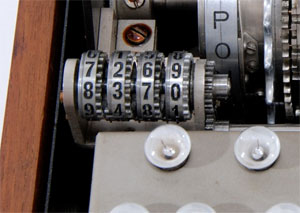
und zwangläufiger Kupplung der Chiffrierwalzen. Translated: Lamp-Enigma with counter and coupled cipher wheels. It has a cog-wheel driven wheel-turnover mechanism that features irregular stepping, making it cryptographically much stronger than the Enigma D. The image on the right shows such a machine. The cog-wheels are clearly visible in between the coding wheels. The counter is at the left. |
|
|
The machine is often referred to as the Enigma G because later production series had serial numbers starting with the letter 'G'. This is, however, not the case for all Zählwerk machines; the earlier machines had serial numbers starting with the letter 'A'. The code breakers at Bletchley Park called it the 11-15-17 machine, after the number of notches on each wheel. The machine is also called the Abwehr Enigma as it was used to some degree by the German Secret Service, the Abwehr, during WWII. It should be noted however that this was not the only cipher machine used by the Abwehr, and that the machine was also used by civil and military customers in several countries, including Hungary and The Netherlands. In practice, the machine was mostly called Zählwerksmaschine or Zählwerk Enigma (Counter Enigma) which is the name we will use on this page. The Zählwerk Enigma was built in several flavours and was improved a number of times. Furthermore, a smaller variant (model G31) was introduced in 1931. We should like to thank Frode Weierud in Switzerland for his help in sorting out the history and the various models of the Zählwerk Enigma. His research in the German Archives has proved invaluable on more than one occasion. |
